Real-world efficiency is competitive, so if you can keep the Raval charged at home and ideally on an electricity tariff that gives cut-price rates overnight, it’ll be very cheap to run.
Electric range, battery life and charge time
The smallest battery in the Raval is 37kWh in size, and has a claimed range of up to 203 miles. Upgrading to the larger 52kWh pack is a worthwhile investment, because not only do you get more power, but the range increases to a maximum of 276 miles on the WLTP test cycle too. The more powerful VZ offers 239 miles of range with the same 52kWh battery.
When we tested the V1 with the 52kWh battery, we saw an estimated range of 237 miles from the trip computer. Efficiency on a route that included a number of motorway miles was 4.5 miles per kWh, which is good for a range of 234 miles. It’s worth noting a heat pump is optional (£960), so driving range might be impacted in cold weather. The Renault 5 has a heat pump as standard.
The 37kWh models are capped at 88kW, making for a 10-80 per cent charge in 23 minutes. It's only a minute longer for the larger battery, because it can be recharged at up to 105kW.
| Battery size | Insurance group | ||
| Raval V1/V2 37kWh | 37kWh | 203 miles | 14 |
| Raval V1/V2 52kWh | 52kWh | 276 miles | 20 |
| Raval VZ | 52kWh | 234 miles | 22 |
Insurance groups
Ratings start in Group 14 for the Raval V1 with the small battery, while adding the 52kWh pack bumps it up to Group 20. V2 cars are in the same insurance groups, while VZ and VZ Extreme versions are slightly higher, in Group 22. In comparison, the Renault 5/Alpine A290 sits in groups 18-29.
Low P11D prices will help the Raval find favour with company car users, where its zero tailpipe emissions mean annual Benefit-in-Kind (BiK) costs are low. But the Renault 5 is cheaper still, if you want even bigger savings.
Residual values increase as you climb the model range, although they are largely similar across the board. The Raval V1 with the 37kWh battery is at the bottom end of the ranking, at just under 46 per cent, while the VZ is marginally stronger than the VZ Extreme, at 47.3 per cent. These figures are well ahead of the Cupra Born (in the 40 per cent range) and are slightly ahead of the Renault 5, too, which is in the 45-46 per cent bracket, but match the Alpine version.
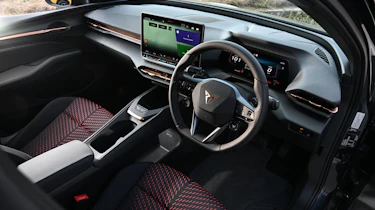
The Raval gets a contemporary look inside and out, with a good, if slightly fiddly infotainment offering.
|
|
While some rivals go down the retro-inspired route, the Raval is thoroughly modern. It carries many of Cupra’s familiar styling cues, such as bronze badges and detailing, angular bodywork, intricate headlights and funky wheel designs in 18 and 19-inch diameters. In our eyes the Raval looks better proportioned than the larger Cupra Born, although the diffuser in the back bumper is overstyled.
Interior and dashboard design
There are more familiar touches inside the Raval, with a sharp fold that runs the width of the dashboard and copper trim for the air vent controls and the tops of the door cards. V1 cars feature fabric upholstery, but it’s nicely made with a bright orange accent that gives it a lift, while the sporty VZ trim adds artificial leather.
Materials and build quality
There’s a carbon fibre-effect finish to the plastic trim that stretches across the width of the dashboard, but it feels a little cheap when compared with the softer material used across the top of the instrument binnacle. There are harder plastics for the centre console and door cards, but they do feel sturdy. There are no glossy materials used inside, so it should stand up to everyday knocks and scratches easily.
Infotainment, sat-nav and stereo
With a multifunction steering wheel and a headlight control panel to the right of that, plus hazard and central locking buttons, but that’s about it. The rest of the cabin functions are operated via the touchscreen, but this is well positioned front and centre of the dashboard.