He's the mononymic designer who has been charged with rescuing Gucci from plummeting sales. So where better for Demna to stage his third catwalk show than at the forefront of commerce – a purpose-built Gucci shop.
During Milan fashion week on Friday, the designer transformed a convention centre into a sprawling retail space that mirrored the design for the brand's new boutiques.
Amid giant stone columns and slabs of Paonazzo marble (in the show's case, fake), guests including Romeo Beckham, Bianca Jagger, Cardi B and Edward Norton sat on plush couches surrounded by shelves displaying pieces from Demna's previous collections. Sales assistants hovered close by, available to answer any questions but, to the disappointment of some VICs (very important clients) hoping to indulge in retail therapy, unable to carry out any actual sales.
Demna, who joined the house last July, said he had spent the first year "dedicated to understanding and formulating what Gucci stands for". He described the show as "his complete personal vision for the brand", explaining that his research has taught him that Gucci "is about luxury that wants to be seen".
Until 2022, Gucci, which is owned by Kering and accounts for roughly half of its sales, was thriving. However, when Sabato de Sarno did a sharp U-turn from his predecessor Alessandro Michele's theatrical romantic vision to minimalism, the brand plummeted. Over three years, revenue almost halved.
Demna, who during his 10 years at Balenciaga transformed it into a luxury powerhouse, has now been tasked with making Gucci relevant again.
There are hints that he is on the right path. In July, Kering reported a return to growth with the company crediting Demna's new collections. But the pressure is mounting to accelerate a turnaround. Kering's chief executive, Luca de Meo, who joined from Renault last year, has said it is important Gucci is "immediately recognisable and culturally pertinent". Get that right and Gucci's hope is queues will return to its shops.
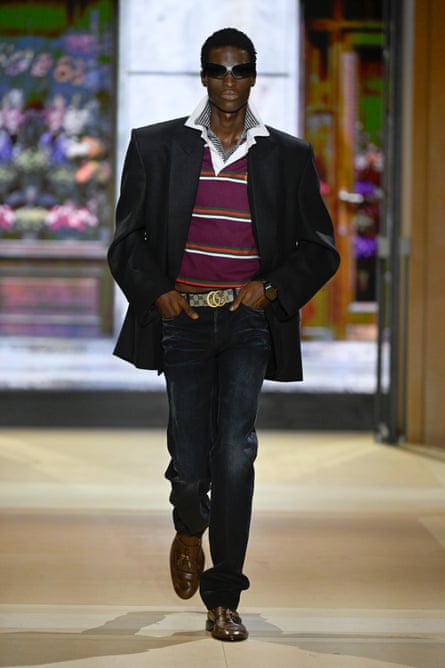
Setting out his new vision on Friday, Demna divided the collection into three character-driven archetypes: "the rebellious aristocrat, the snob and the eccentric", with a cast of models that captured its cross-generational appeal.
In menswear, oversized tailoring, loafers and tasselled slippers replaced the muscle tees and skinny jeans from February's catwalk. Jeans hung low on the hips while the brand's signature triple horse-bit belts hung even lower. Blazers featured exaggerated peaked shoulders and despite previously saying he wouldn't do hoodies at Gucci (his signature design at Balenciaga), they did make an appearance.
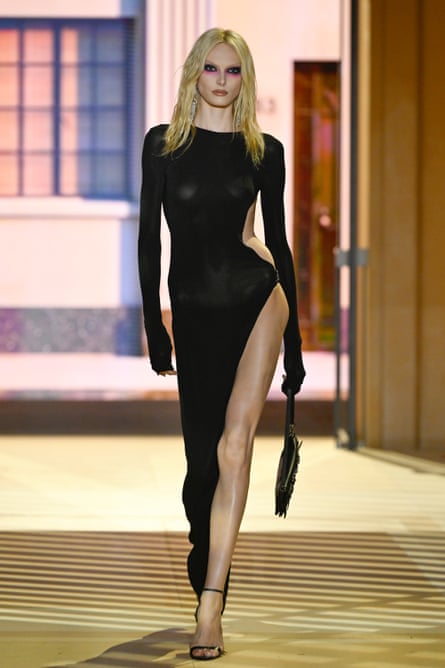
For women, a "study of posh dress codes" led to both rugby tops and neat little skirt suits. Nods to the brand's equestrian heritage came Rivals-coded with spiky-heeled, stirrup-motif riding boots and clingy white jodhpurs. There were plenty of references to bourgeois Italian ladies, now rebranded as "nonnamaxxing" by the TikTok generation, with fuzzy coats and shawls worn with wiggly pencil skirts. London's Sloane Rangers were also acknowledged with pleated A-line skirts in Scottish tartans and Oxford shirting. Demna mentioned he liked the idea of bringing Gucci back to its roots, the Savoy hotel, where the brand's founder, Guccio Gucci, worked as a porter during the 1890s.
There were also plenty of references to Gucci's provocative and powerful 90s Tom Ford era. Demna described it as "nocturnal glamour" with bottom-grazing hemlines and metal-heeled stilettos. The model Alex Consani wore a long black dress with a slit from toe to bust, fastened with a bedazzled G logo at the hip, while a slinky and backless dress was loosely secured with a teardrop weight.