This ambitious work of speculative fiction from Israeli-British playwright bites off more than it can chew – but does so with a conviction that makes you glad Flaishon gave it a go.
In the very near future, a company called Memoriam has devised a way of extracting people’s memories and turning them into a lavishly detailed, full-sensory VR-style experience. In the opening scene – which turns out to be the subplot – Becky ( experiences somebody else’s memory of a surprise proposal. She is moved, and agrees to allow the company to use her memory of childbirth.
Becky is attended to by soothingly professional Memoriam employee Rachel (Rachel Barry). At first it seems like she's a soulless corporate drone, but soon we see the ‘real’ her: very neurotic, very single, very Jewish. The soulless corporate drone is in fact her colleague Chris (Ben Wiggins), who brings up the fact that on a boozy work night out, Rachel mentioned that her grandmother was a Holocaust survivor. Memoriam had been planning on extracting the memory of a survivor living in New York, but he passed away just a few days before the process was due to take place. Now Rachel’s 92-year-old grandmother Rivka is literally the last known Holocaust survivor on the planet.
It finds new ways to discuss a painfully familiar topic.
If you think too hard about all this you’ll hit some problems. Nothing wrong with speculative fiction, but keeps moving the goalposts around over what the Memoriam technology actually involves, which means that everyone’s ethical arguments for and against Rivka lending her memories tend to make sense based on what we know at the time.
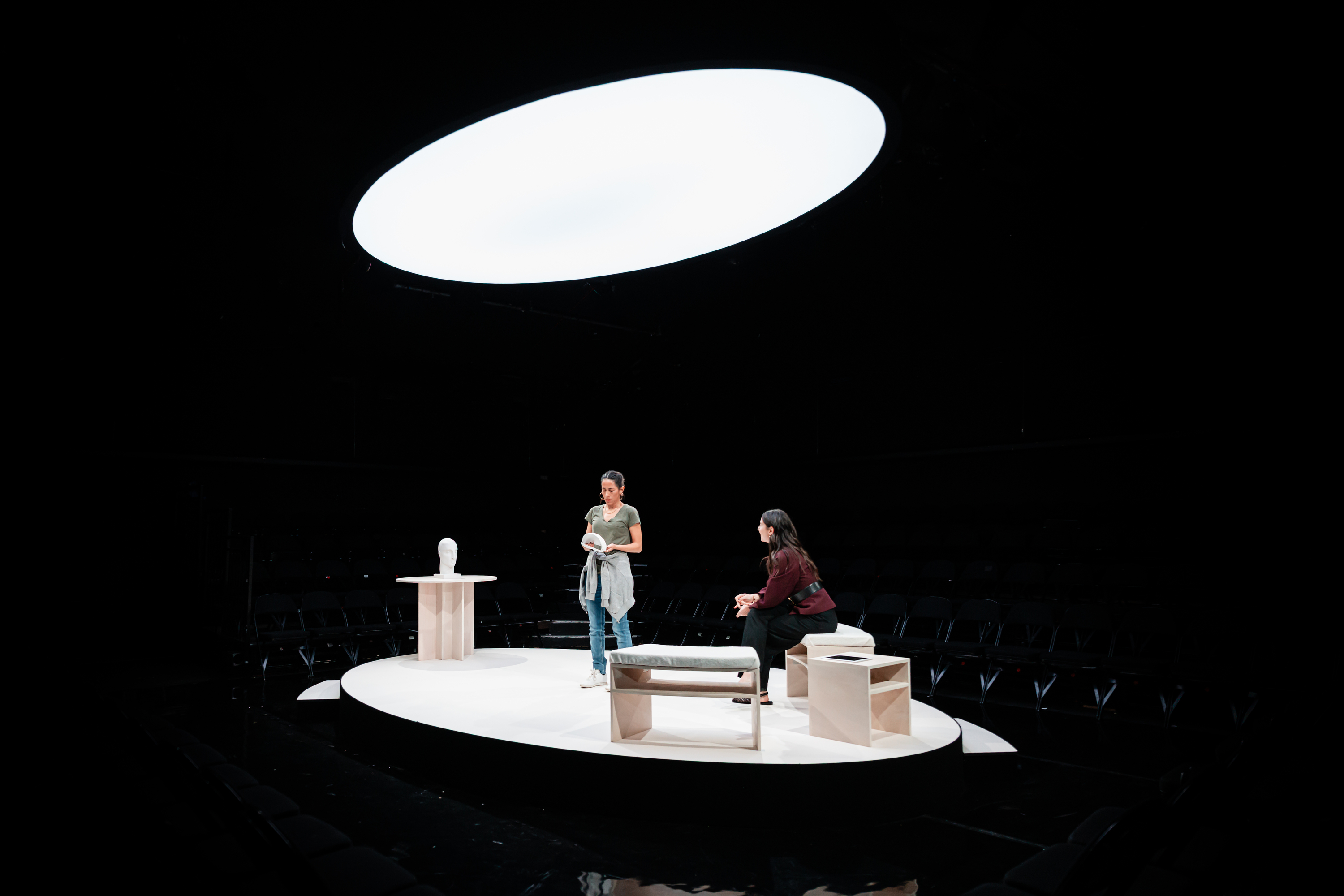
But if you take it as rather an allegory that questions the purpose of remembrance – what it is we literally mean when we say ‘never forget’ – while also (relatively subtly) taking on big tech and commercial appropriation of the Holocaust – then Daniel Goldman’s minimalist production works a lot better. It’s powered by strong performances from Barry and as her fractious brother David: their bickering over who Rivka has confided her darkest memories in feels as much a part of what is trying to say as the stuff based around the flashy tech.
Like I said, it takes too much on in 90 minutes, the drip-drip of ethical revelations feels a bit manipulative, and it’s got a meandering ending. But it’s a smart and moving piece of writing that feels both original and grounded as it finds new ways to discuss a painfully familiar topic.