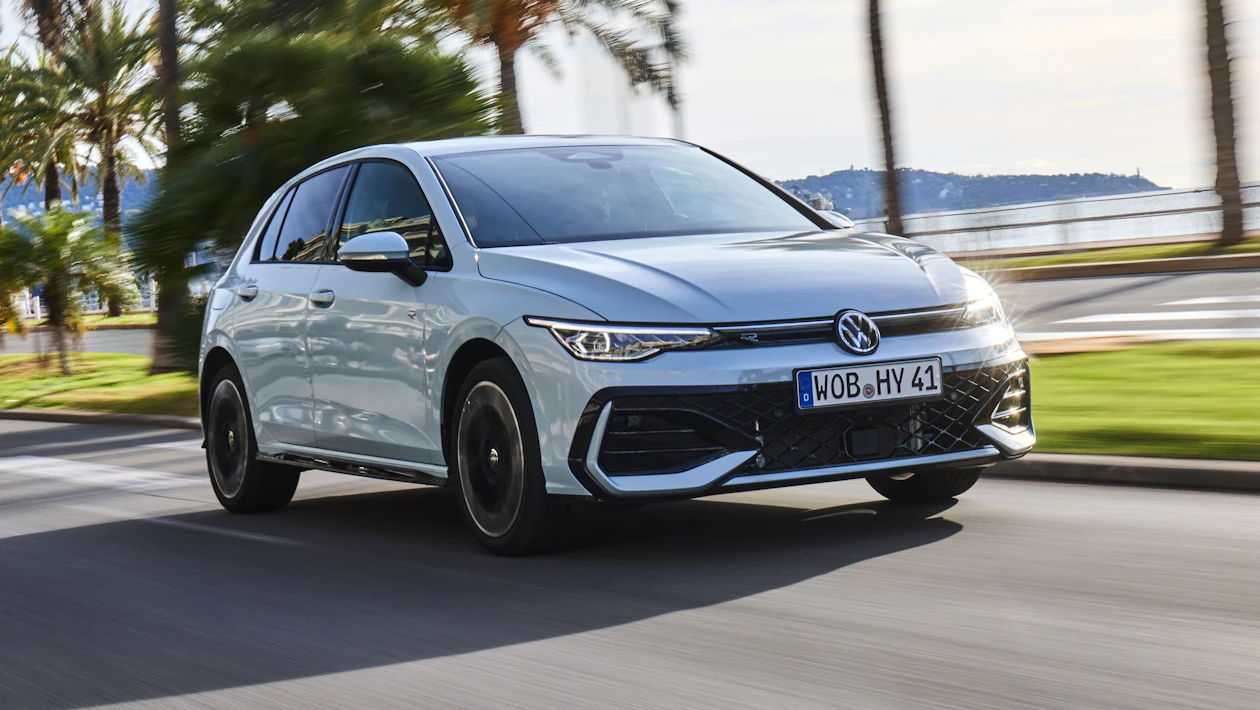
For electric driving, the TSI lies dormant in the Golf Hybrid and the larger propulsion motor sandwiched into the hybrid module is doing the donkey work.
If the battery gets too low in charge to support electric driving, or you ask for a bit more power from the VW, then it switches to series-hybrid driving, where the TSI then powers up but is disconnected from the front wheels. In this case, the ICE is merely sending its power to the secondary generator motor, which in turn tops up the battery to feed the main propulsion motor.
Finally, there’s parallel-hybrid drive. Above 37mph or when asking for a lot of acceleration, a clutch closes and finally the TSI is directly linked to the driven wheels, while the main electric-drive motor then supports the turbo four as a ‘booster’.
That transmission, by the way, is not a single-speed reduction gear as in an EV, nor is it a CVT. We were again told by the team behind the Golf Hybrid that it’s almost like a sixth gear taken from one of its regular ’boxes, with the car limited to a maximum 4,500rpm and, accordingly, a 112mph top speed.
All told, in its more potent configuration, the Golf Hybrid has 168bhp and 310Nm in total, with the hybrid unit constituting 48kg of weight. That means the R-Line’s total kerb figure is 1,484kg, so it can sprint from 0-62mph in a sprightly 7.5 seconds.