Taking the highly popular first Qashqai and building on it for the replacement was a challenge, with Loing acknowledging “the biggest difficulty is to replicate success”. It’s easy to see why the second-gen Qashqai was just as popular, with interior quality taking a visible step up and the driving experience becoming more refined.
While the Qashqai has evolved over the years with new powertrain technology – perhaps the most notable change is the current car’s e-Power hybrid system – something that connects them all is the raised seating position, combined with well mannered driving dynamics. Those traits really helped shape the family crossover sector, giving customers a more commanding presence on the road, without the efficiency compromise or complexity of a 4x4.
The birth of the Nissan Qashqai
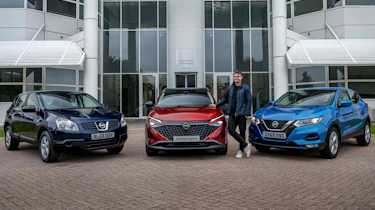
The Qashqai was born out of a difficult period for Nissan. Loing recalled the lead up to the first model. “Nissan’s line-up was a copy and paste of the big boys,” he said, referring to a range that included the Micra, Almera, Primera and X-Trail. Instead of trying to compete with the likes of Volkswagen and Ford in these mass-market areas, Nissan decided it needed to reach new customers.
Loing added that, given the firm’s multi-billion pound debt in the early 2000s, “Carlos Ghosn, the [then] Nissan chairman, was coming every month, and they were not pleasant meetings. The resources of the company were mainly directed to the US because the company needed to recover. So we had not so much [money for a replacement for the Almera]”. That replacement was the B32A concept, a fresh design ready to replace the underwhelming hatch, but it was canned on Friday 13 December, 2002.