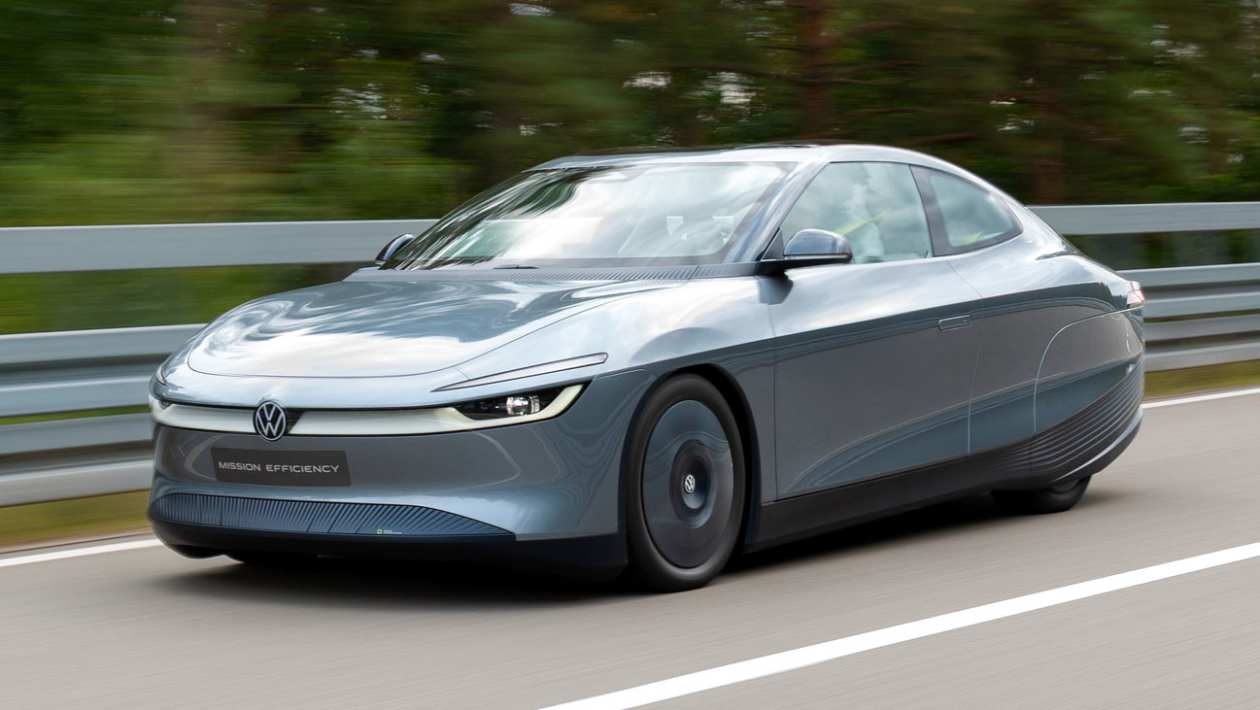
In total the Mission Efficiency’s drag coefficient stands at 0.158. That’s an incredibly low figure when compared to the most aero efficient cars on sale, such as the Mercedes EQS at 0.19 or the Tesla Model 3 at 0.23. Even the ultra-sleek XL1 only had a drag coefficient of 0.19.
VW didn’t give us a kerbweight for the Mission Efficiency, but it has taken steps to slim it down from the ID. Polo’s rather portly 1.576kg figure. The front wings, doors, bonnet and bootlid are made from carbon fibre reinforced plastic, while most of the underlying structure from the A-pillar backwards is aluminium.
Opening up the Mission Efficiency from the flush-fitting door handles, the first thing that strikes us is that it’s a 2+2, unlike the XL1 which was a mere two-seater. Despite the focus on efficiency, it’s surprisingly practical. There’s plenty of space inside for a family, with a double-bubble roof aiding headroom, and even though there’s a huge 481-litre boot (thanks to the compact torsion beam rear), pop open the wheel covers and you get a 16-litre storage cubby on one side and space for charging cables on the other.
The cabin is a very simple affair, however. There’s the same steering wheel as on the ID. Polo, a smaller driver’s display taken from older VW models and instead of a proper touchscreen, there’s a movable tablet from a third-party manufacturer. To reduce weight, there are no electric controls on the doors and the bespoke seats made from recycled material are only adjusted manually. There’s also no sound system, with audio coming from a Bluetooth speaker instead.
Despite the simplicity and some questionable finishes to the window surrounds and plastics, the Mission Efficiency doesn’t appear too far away from being production ready. Stefan Voswinkel, Head of Product Communications, told Auto Express that discussions are ongoing about turning the Mission Efficiency into a car that can actually be bought.
He confirmed: “We’re still looking at making this into a production vehicle.” Asked about potential pricing on the Mission Efficiency should it come to market, Voswinkel said that we could expect a price tag of around 50,000 euros (roughly £42,000).
Kai Grunitz, head of development at the Volkswagen Group added: “Our team has impressively demonstrated that you can build the most efficient car in the world with affordable large-scale production technology.”
Considering the original XL1 was limited to just 250 units at almost £100,000 a pop, there’s plenty to interest efficiency enthusiasts if the Mission Efficiency comes to market – although as things stand, that remains a big ‘if’.
The new Volkswagen ID. Polo may have only just arrived in the UK, but go to the Auto Express Find A Car service and you can enjoy an average saving of over £2,000 on VW’s new electric supermini.