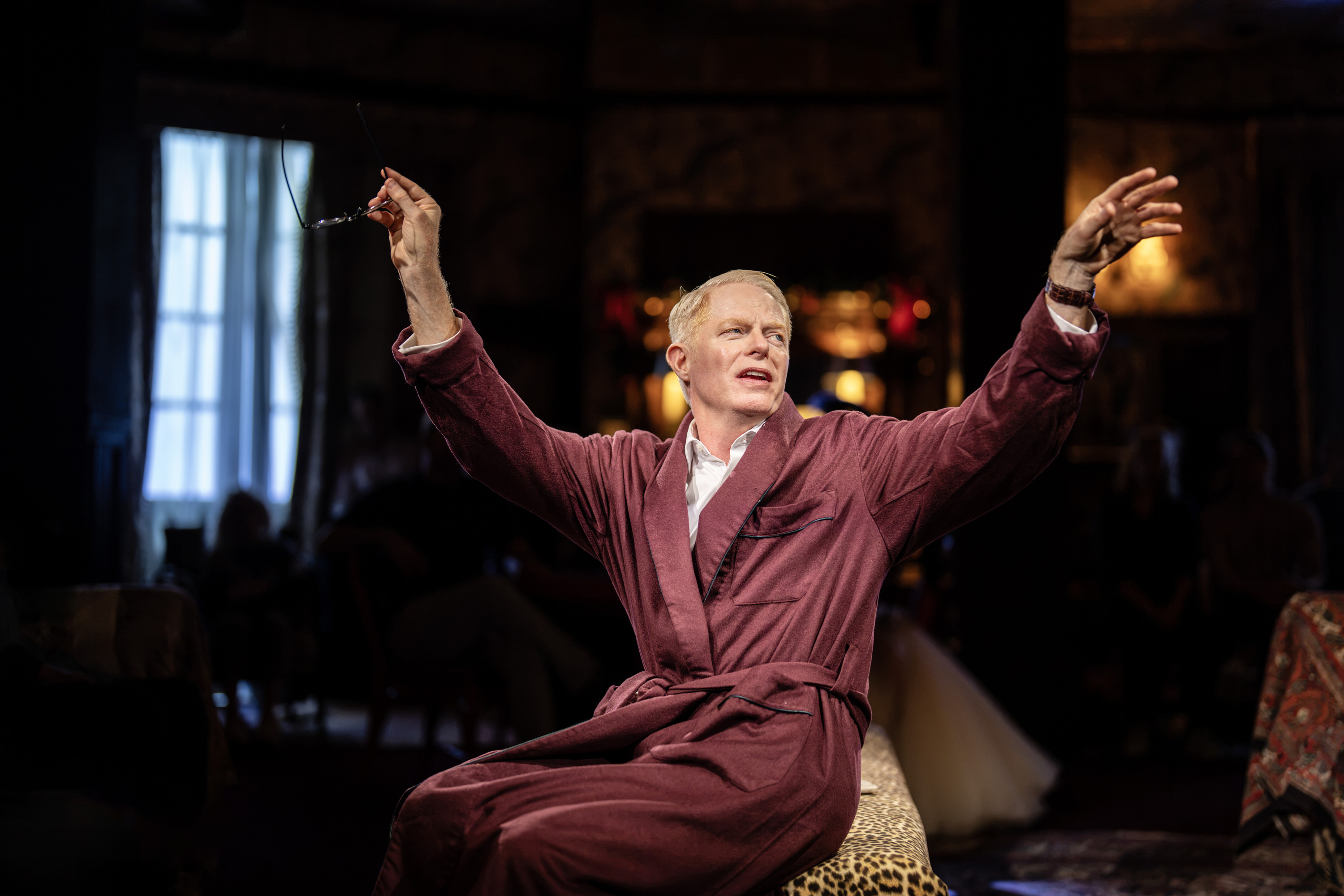
This revival of Jay Presson Allen’s 1989 Truman Capote monologue was initially staged in the stunning House of the Redeemer in New York, the sort of opulent old Manhattan building of your wildest dreams.
How would a London transfer work? Well, as the saying goes: if you can’t bring the mountain to Mohammed, then bring Mohammed to a lavishly detailed copy of the mountain. A huge part of the joy of the London is how designer Paul Farnsworth has transformed the entire Menier space into what I’m going to call a faithful recreation of Capote’s New York apartment. Sure, if you look too hard at the panelled ceilings or the tapestry covered walls you’ll realise they’re just printouts on fabric. But one, well, yes, obviously; and two, it still looks incredible. While presumably Capote’s lounge didn’t look exactly like this (I’m sure it had less seating capacity for starters), the level of detail is astounding, from vintage rugs and sofas to shelves groaning with knickknacks, books and even handwritten letters.
The actual play can’t really live up to the magnificence of the setting. That’s not the fault of performer Jesse Tyler Ferguson, who offers a funny, often very poignant channeling of the Alabama-raised author and socialite. That distinctive voice could so easily fall into parody – it was half a parody already. But Ferguson brings Capote to life, aided by the fact that the play is set at a very painful time in his life. It’s 1975, and he has recently published a chapter of his (ultimately unfinished) magnum opus , and its savage depiction of the super-rich has spooked much of Capote’s social circle.
It’s a very rich seam to dig into, but the problem with is that it’s true. Or rather, Allen largely sourced it from Capote’s own correspondence (she said 70 percent was his words verbatim) and as you imagine, he didn’t craft a perfect three act monologue, but rather wrote sundry letters and diary entries that have been stitched together here.
Ferguson’s lugubrious tone and charismatic performance – witty, self-pitying, caustic, irrepressible – does a hell of a good job of persuading us that this is one continuous coherent train of thought. But the fact is it’s not, as inevitably he moves from subject to subject without an entirely satisfying structure. His scathing early musings on the emptiness of the one percent are blisteringly perceptive and impressively relevant to our present moment. But before too long he’s moved on, never to really return. Even the whole thing about his social ostracism feels vague at times as he rhapsodises about his recent trip to Studio 54 with pal Ava Gardner.
The addition of Charlotte D’Amboise as a character credited as The Swan – an elegantly dressed stand in for the various influential and absent women in Capote’s life – does give it all a bit more theatricality. But she doesn’t really have that much to do beyond giving off ethereal vibes.
Rob Ashford’s production is very classy indeed and worth it for the design alone. It’s a very enjoyable , beautifully staged. Maybe it’s not a great play, but it’s 90 minutes in as close to the real Truman Capote’s company as you’re ever going to get.